This month: A review of Stephanie Wambugu’s buzzy debut, Lonely Crowds. • We polled readers on their favorite beach reads. • A dispatch from Michael M. Grynbaum’s book-release party in the former Condé cafeteria. • The July books that are actually worth the cost of an overpriced office lunch. |
|
|
| Senior newsletter editor, New York |
|
|
Fraught Female Friendship, But Make It Queer A mesmerizing novel explores the ambiguous space between friendship and romantic love. |
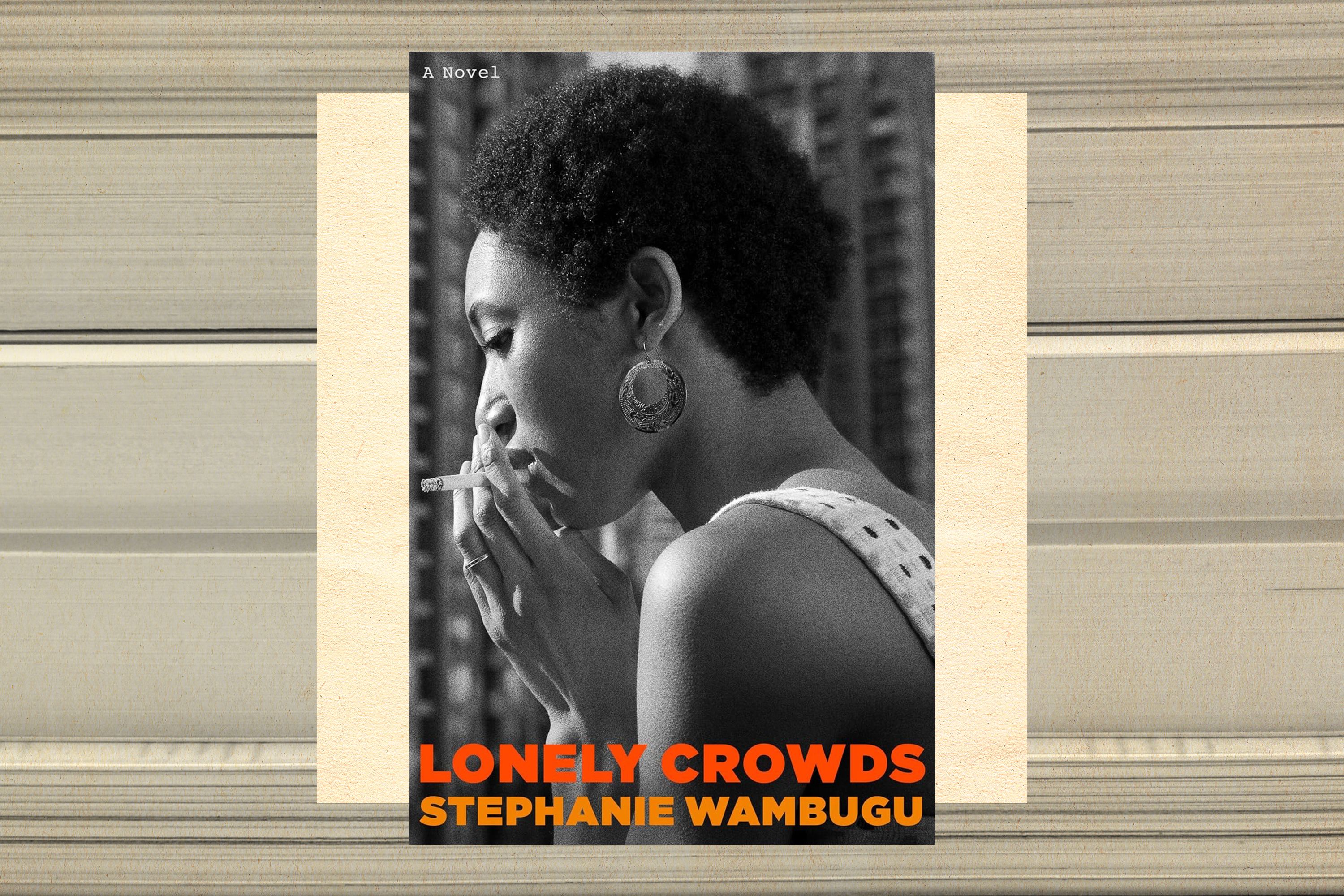
Photo-illustration: by The Cut; Photo: Retailer |
Stephanie Wambugu’s uncommonly elegant debut novel opens on a note of deflated celebration. The narrator, Ruth, is gathered around her birthday cake with her husband, friends, and neighbors, but her friend Maria, who taught Ruth that “without an obsession life was impossible,” is missing from the packed room. “I’d forgotten,” Ruth thinks. “Now, I remembered.” A painter born to emotionally distant Kenyan immigrants, Ruth’s baseline skews polite and well-behaved, so instead of making this “epiphany” heard, she stifles it, feigning contentment and making conversation with her mentor. In the following days, multiple people ask her if she’s okay. At her New York art opening, where she meets up with her “husband and other strangers,” she drunkenly mistakes one of them for Maria. Despite the night’s success — all her paintings sell — she ditches the after-party and passes out alone in her hotel room. “I started the story from the beginning before falling asleep,” she says.
Lonely Crowds unfolds as a coming-of-age story with whiffs of Toni Morrison, Jamaica Kincaid, and Elena Ferrante. The scope is ambitious; Wambugu, who is also an editor at Joyland Magazine and shares her Kenyan origins with Ruth, follows the friends from their childhood in Providence attending a mostly white Catholic school into their early adulthood in ’90s New York City. Ruth is 9 years old and entering the third grade when she first glimpses Maria, a poor Black girl from Panama who, after losing her bipolar mother to suicide, is living with her aunt who suffers from the same condition. For Ruth, it’s destiny at first sight: “I had been nervous about the new school, and knowing that Maria awaited me had transformed my anxieties into pure interest,” she thinks. “All we needed to do was see one another again and our lives would begin.” She isn’t wrong. At school, they are drawn to each other and Maria soon spends most days at Ruth’s home.
According to Ruth, Maria is the brilliant one. She has the talent, wit, and confidence that Ruth dreams of, and it occasionally gets her into trouble. Even as a young girl, Maria is the initiator, far more familiar with the world of adults. She has a relationship with their music teacher that can only be read as inappropriate even though no explicit revelation ever comes. “I often listened without understanding, hoping someone would enlighten me,” says Ruth, who is happy to live in Maria’s shadow. “I wasn’t sure if awareness would come with age or if I was just dull.” The two share a physical space — Ruth’s bed, bathtubs, clothes — and later, dreams of upward mobility. What Maria wants, Ruth learns to want; Maria poses for Ruth’s drawings and tells her they’ll both go to art school.
Any woman who has experienced deep friendship with another knows it’s complicated. With time, it only gets worse. You get stuck in the same stories, with the same roles. You know each other so well that the weight of what goes unsaid over the years eventually makes it near impossible to be honest. Love becomes envy and turns into resentment, and the person who loves you most also knows how best to wound you. Lonely Crowds lives in the margins of desire and jealousy, intimacy and individuation, certainty and ambivalence. But it’s most interested in that tantalizing, agonizing ambiguity that young queer girls can share between friendship and romantic love.
Once Ruth and Maria arrive at Bard, the two friends start to go their own ways, and their new distance makes their less frequent interactions increasingly charged. Ruth’s obsession with Maria becomes complicated by her physical desire for her — which surprises her each time it surfaces in a touch or a prick of jealousy. While Maria comes out as a lesbian and settles into a relationship with a wealthy girl who picks up on some kind of vibe between the friends, Ruth dallies with a moody English boy and has her first awkward same-sex experience. But even after Maria initiates sex with Ruth, things between them remain unclear. Is Ruth a repressed lesbian, like Maria claims? Is Maria bipolar, like her mother and aunt were? Does Ruth have romantic feelings for Maria? And does Maria return them?
Much of the novel’s power comes from its unanswered questions, which are allowed to remain unresolved in part because Ruth is a remote and unflappable narrator, giving the fine-tuned appearance of being direct without actually revealing much of what she wants. Ruth’s nonchalance often comes encased in a delightful deadpan. When assigned to read Three Lives at Bard, Ruth says, “I had never heard of Gertrude Stein before and was interested to learn she had lived in Paris, slept with women, and repeated herself a great deal. That sounded like an interesting life and indeed the book had been interesting, more than interesting.” Despite experiencing “nothing short of rapture” reading Stein — a famously gay woman — she sits silently in class. “If I spoke,” she explains, “I risked saying not only to others, but to myself, what I had denied without even knowing I had denied it.” What she has denied knowing, she doesn’t tell us. Ruth’s supposed reliability is often leveraged to hide deeper truths, especially from herself.
The echoes with the My Brilliant Friend quartet, which is built on a frame narrative establishing the non-narrating friend’s disappearance, are unmissable. Though Wambugu’s spin is explicitly queer, Black, and focused on first-generation immigrants, the dynamic each book explores feels just as alive between fledging visual artists in New York City in the ’90s as it does between aspiring writers on the poor outskirts of Naples in the ’50s. Wambugu’s prose has a propulsive, almost hypnotic drive, and she knows how to keep it moving, getting through about as much time in one book as Ferrante does in three. At times, that flow comes at the expense of physical or sensorial detail; we only know that Ruth and Maria look alike because a few people mention it in passing. Like everything we learn about these characters, their likenesses and differences are funneled through Ruth’s perspective, which in time reveals itself to be more limited than we may have initially suspected.
The only problem with this whole equation is that Maria seems like a pretty shit friend. The novel tends to treat Ruth’s desire to stick with her as a given, relying on how identifiable this dynamic is without making Maria feel like a whole person. While those familiar with the tumult of a close female friendship can use Maria as a placeholder for their own more brilliant demons, a reader of the genre can’t help but miss Lila, who pushes Lenù to become the best writer she could despite her cutting comments, her cunning. Lila is mesmerizing precisely because she is frightening, vivifying the girls’ drab childhood. With such a formidable precedent, you can’t help but ask, is Maria ruthless enough? And is she as brilliant, as bold, as superior as Ruth would have us believe?
Objects of obsession are always standing in for what we want them to be, and Lonely Crowds is a thrilling and capacious novel about intimacy and art-making in which the narrator proves to be more compelling than her muse. Even if I wanted to be as infatuated with Maria as Ruth is, the book is seductive, so much so that I almost forgot Maria’s initial absence. Wambugu delivers on that mystery with a gutting final encounter that’s both shocking and inevitable, true to the melancholy that underpins Ruth’s whole story. Even her happiest memory — an evening lying on the campus lawn, carefree and absinthe-drunk with Maria and their friends — is punctured by impending loss: “I longed for it before it was over.”
|
|
|
What Book Gossip Subscribers Are Reading This Summer Selected answers from last month’s survey. |
-
Leigh Stein's If You're Seeing This, It's Meant for You (!!!) I have an advanced copy and it's sooo good. TikTok hype-house Gothic-literary dramaaaa.
-
The Get Off by Christa Faust, a brilliant, turned-to-11 dissection of pulp fiction that puts an unwillingly pregnant woman in the most male-coded environment ever (rodeo!) and sets it all on fire, figuratively and literally. It’s a breathtaking, brilliant book.
-
Baldwin: A Love Story by Nicholas Boggs [Ed. note: This book will be released August 19.]
- Bonjour Tristesse by Francoise Sagan and Canto yo y la montaña baila by Irene Sola.
-
I'm heading to the Hamptons from Atlanta to visit friends, so I'm reading the new 100th-anniversary annotated Great Gatsby. I read it in high school, but it's so different now that I'm older (47). The annotations are great, sometimes explaining words or phrases that have become outdated or just to add context. With the Bezos wedding this week, it's even more interesting, and shows not much has changed in 100 years.
|
|
|
Inside Michael M. Grynbaum’s Elite Launch Party For one night, the old Condé Nast cafeteria was returned to its old-media glamour. |
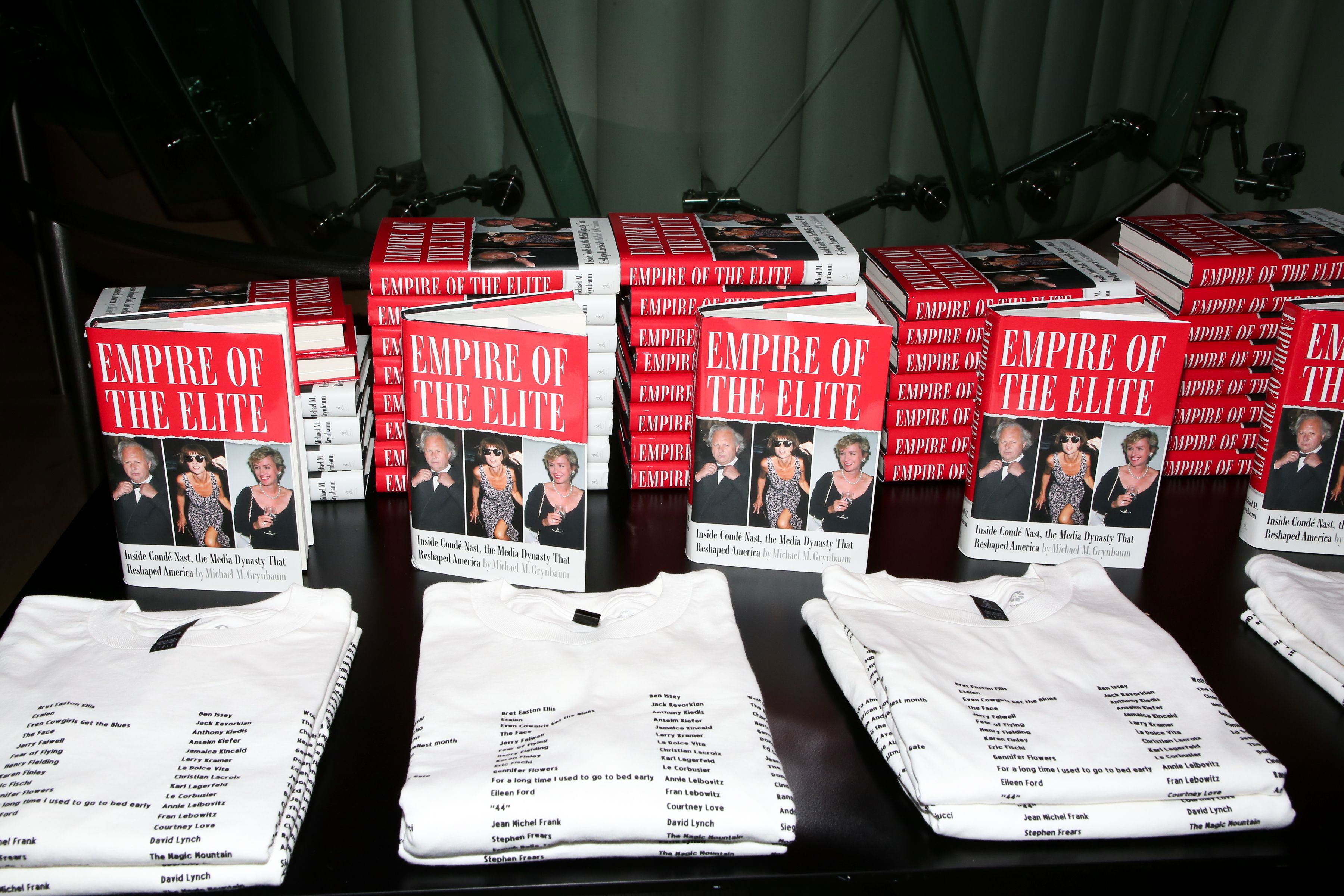
Photo: Madeleine Thomas/BFA.com/Shutter |
It’s now called Well& by Durst, the publicist informs me. A diabolical name for the old Frank Gehry–designed Condé cafeteria, once one of the most self-consciously glamorous rooms in New York. After it opened in 2000, it was breathlessly reported on for many years: An entire 2003 Observer article, with quotes from Ruth Reichl and New Yorker cartoon editor Robert Mankoff, was dedicated to the fallout after a grill operator named Felix Tagliarini was “mysteriously shuttled to the sandwich station.”
Condé Nast has moved downtown; the cafeteria now serves food to employees of TikTok, the company currently occupying most of the office on this floor of 151 West 42nd Street. Last Wednesday, it slipped into its old costume for the launch party of Empire of the Elite, Michael M. Grynbaum’s nonfiction book about the magazine company. I arrived 20 minutes after it started, worried I might be late (the event was slated to go only for two hours), but barely ten people were there, including Molly Jong-Fast and Taffy Brodesser-Akner. To the room’s left, in an area that hadn’t been Gehry-fied, TikTokers peered in without much interest.
Things filled up slowly, then all at once. On a table at the front was a pile of T-shirts printed with the 178 people, places, books, and films that aspiring Vogue assistants were quizzed on in the 1990s, and the party was in the same spirit: The guest list was the main event, and it’s hard to describe the scene without running through it. Audrey Gelman and Jane Pratt were there; so were Michael Barbaro, Maureen Dowd, Ben Smith, and New York Times executive editor Joseph Kahn. Also spotted were Liana Satenstein, Rachel Tashjian, Naomi Fry, Derek Blasberg, and a pack of my New York Magazine colleagues. When Grynbaum, in a short speech, mentioned the “amazing irony” of the TikTok takeover, Cat Marnell, wearing a white cutout dress (almost everyone else was in their best officewear), booed loudly. Although the most elegant, swoopy part of the cafeteria is situated toward the windows, attendees clustered in the darkest corner by the buffet, where the sliders and cheese platters went largely uneaten.
Except for Graydon Carter and his posse: They stood away from the crowd in a secluded nook by a window. Someone said to me, “I’m not sure if I’m allowed to go over there.” —Emma Alpern, senior copy editor, New York |
|
|
Subscribe now to get unlimited access to everything New York, including subscriber-only newsletters, exclusive perks, the New York app, and more. |
|
|
The June Releases You Should Buy, Skip, or Put on Hold at the Library |
Long Distance, by Ayşegül Savaş
Ayşegül Savaş has made a career writing books with minimal plots in mostly unnamed cities. They’re marvels of interiors and interiority, taking place in monkish apartments and artists’ studios, studies of atmospheric changes in emotion. In her first short-story collection, Savaş sends her characters on trips that promise to change them, from a student’s semester abroad in Russia to a layover in Paris to a trip to Marseille that marks a new mother’s first real vacation. Savaş is best when depicting a single, unspoken moment that fractures a relationship, revealing, with balletic restraint, that two people never knew each other the way they thought. While her characters want to believe in the metamorphic potential of travel, Savaş deftly shows that the most important transformations happen in subtle moments of disconnection. —Borrow, Rachel Stone, fact-checker, New York
If You Love It, Let It Kill You, by Hannah Pittard
Writing professor Hana seems to lead a charmed if slightly boring life. She has a house, a spouse-equivalent boyfriend, and a raucous family who all live nearby. But upon learning that her ex-husband, who cheated on her with her best friend, is publishing a book with a character based on her, she sinks into a state of existential despair. So far, so similar to the author’s real and very on-the-record life. Twist: Hana then rescues a talking cat who disrupts the chronology of her story and her perspective on her life. While not exactly plot-driven, the novel is never less than entertaining, mostly because Hana and the quirky cast of characters are so vivid and idiosyncratic. —Buy, Emily Gould, features writer, New York
Immortal Consequences, by I.V. Marie
This thrilling debut alternates perspectives between six Blackwood Academy students as they compete for the once-in-an-afterlifetime chance to get out of an endless cycle of magic classes and day jobs reaping lost souls. Some of the tropes may feel familiar, but together they weave a world all its own. It’s a fast-paced YA fantasy that truly has something for everyone eager to tear through a new world for their next vacation read. There’s magic. There’s an enemies-to-lovers plotline. And a cliffhanger that will leave you eager for the next novel in the series. —Buy, Ashley Wolfgang, newsletter editor, the Strategist
|
|
|
-
Did the clickbait-y Gary Shteyngart headline work on you? “Is Gary Shteyngart One of the Last Novelists to Make Real Money From the Craft?” left us with more questions than answers. After Book Gossip mother Emily Gould mused in Dinner Party that his wife’s attorney salary probably contributed to his watch collection and house upstate, the writer confirmed he and his wife earn about the same — and that he pays for his own watches.
- Speaking of summer reading, we love Granta’s survey of what writers are reading now.
- This picturebook about Zohran Mamdani promises to be cute.
-
Gwyneth Paltrow’s dog learned French, and more revelations from Amy Odell’s Goop biography.
- That memoir about a couple forced to live an itinerant life after the husband’s terminal-illness diagnosis that was just adapted into a film starring Gillian Anderson and Jason Isaacs? Turns out it was largely untrue.
-
The lowdown on why authors are getting weird on Substack — and for how much.
- Would you buy this admittedly enchanting organza book pouch for $45?
- Roddy Doyle, Ayọ̀bámi Adébáyọ̀, Sarah Jessica Parker, Chris Power, and Kiley Reid have chosen their Booker Prize longlist.
-
Two signs that next year just might be better than this one: a new George Saunders novel exploring another liminal space between life and death and a Ben Lerner novel about failing to record a very important interview.
|
|
|
|
Join us for a lively evening newsletter about everything that just happened. Sign up to get it every weeknight. |
|
|
https://linkst.thecut.com/oc/63b4a151a01eb21c80050eaeocoyk.wn0/9c02357e
|
|
|
|